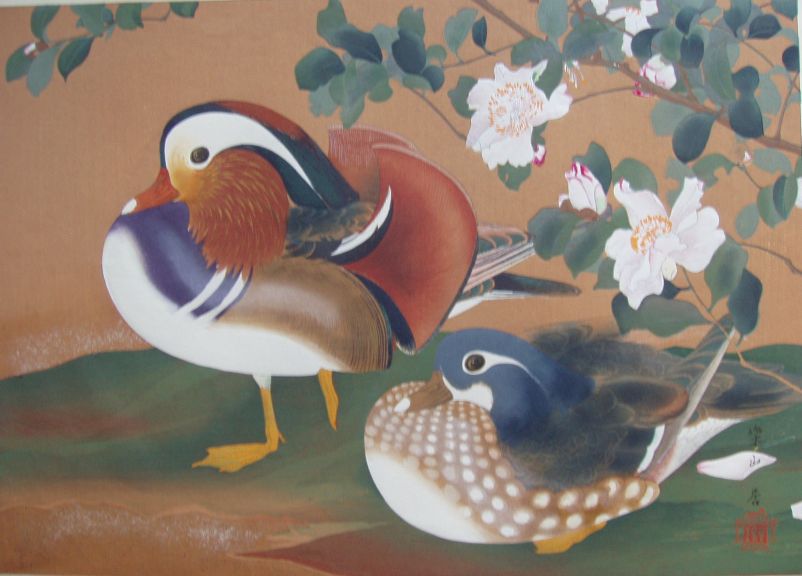

山茶花に鴛鴦 (冬) [on the print*]
sazanka ni oshidori (fuyu)
Sasanqua Camellia and Mandarin Ducks (Winter)
山茶花に鴛鴦 (冬の部) [on the folio*]
sazanka ni oshidori (fuyu no bu)
Sasanqua Camellia and Mandarin Ducks (Winter Division)
サザンカにオシドリ(冬)
[*Rakusan included の部, no bu, 'division', only on the pre-printed folio labels and omitted it in the final versions of the title-captions on the woodblock prints.]
Original Number
5
ADDITIONAL NOTES FOR THIS DESIGN
| Edition I: | 楽山居 | Raku-zan Kyo | + Seal F |
| Edition II: | 楽山篁子生 | Raku-zan Kou-shi-sei | + Seal A |
| Edition III: | 楽山篁子生 | Raku-zan Kou-shi-sei | + Seal B |
[For illustration of seals listed by seal code letter, see the Seals article. For edition characteristics applicable to this series as a whole, see the Edition article.]
Design History:This woodblock print was produced from an original painting on silk dating from the late 1920s whose current location is unknown. The indentification of this design as number 5 is original to Rakusan who published the print as the 5th design in his series of one hundred woodblock prints called 楽山花鳥畫譜, Rakuzan Kachou Gafu, lit. 'Rakusan's Flower and Bird Print Series'.
5 is one of the very few Rakusan designs for which any printing details exist. The Foster booklet reports that 5 required 220 printing impressions to complete.
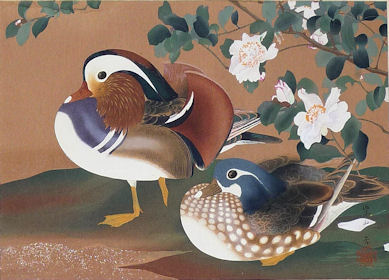
Edition I: The details of the initial publication of 5 are known precisely because copies of the delivery documents for installments two and three have survived. The design was first announced as upcoming in the documents for installment two sent out on June 10, 1929. The first print run of about two hundred copies was completed July 18, 1929 and the publication date was July 20, 1929 in installment three (of fifty). At least one or two additional full print runs of 5 were made before the series was completed in mid 1933 and edition I printing ceased. Three quarters of all documented copies of 5 come from edition I. The different copies illustrated at top above and below left are typical of edition I.
Edition II: 5 was reprinted in edition II in a single, smaller print run, probably late in the period between 1936 and 1941. As noted below, an edition II copy of 5 appears in the Foster booklet and served as the model for his fine art reproduction. Because 5 is the only actual size Foster reproduction, any edition II copy of 5 should be carefully examined under a magnifying glass to determine whether the image is an original woodblock print or a machine-printed reproduction. Unfortunately, the best other comparable image of an edition II copy of 5 (illustrated at center below) is cropped at the bottom, and the fading at left is a photographic artifact.
Edition III: After the war 5 was reprinted in a single, very small print run sometime between 1948 and 1955. In order to accommodate the Foster cursive Rakusan romaji signature, Rakusan shifted the edition III seal up and to the left. (In the other two editions the seal is in its usual position directly below the woodblock-printed kanji signature.) A typical edition III copy of 5 is illustrated below right.
Although the ink colors used in all three editions are similar, there is a lot of individual variation, especially in the bokashi shading, which makes defining consistent, edition-specific characteristics more difficult.
 |
 |
 |
| 5 (edition I) | 5 (edition II) | 5 (edition III) |
5 is among the most familiar Rakusan designs because of Walter Foster. In addition to marketing original Rakusan woodblock prints of 5 from Japan, Foster also sold two grades of reproductions which he had machine-printed in the USA. Both reproduction versions were created from the same original model, an edition II copy of 5 in Foster's personal collection. One version is a fine art reproduction produced for individual sale, and the other appears as a centerfold, double-page-spread, as pages 16-17 of the Foster booklet.
The fine art reproduction was produced to very high standards of photolithography on good quality, heavy matte paper; and the inks were carefully color-matched to those of the original woodblock print. Because of this attention to detail, it was relatively expensive, few copies were sold, and they are seldom encountered today. Regrettably, the booklet was inexpensively and inexactly machine-printed on semi-gloss paper, and its illustration colors are not true to the original. There is an overall yellow tinge to the booklet illustration. Few booklet page reproductions of 5 are today sold separately because of the heavy vertical crease (and staple holes) in the middle of double pages 16-17. Initially, Foster sold original woodblock prints of 5 for $25, fine art reproductions for $6, and the entire booklet (with 27 different designs) for $1. Because the Foster booklet was printed in great numbers, it remains widely and inexpensively available today.
5 was one of Foster's favorite designs, and 5 is the only design he chose to print both reproduction versions at approximately original size. All Foster booklet measurements are only rough approximations, and the original is listed as both (13" x 18") and (13.5" x 18.5"). However, the size of the fine art reproduction (listed as 12" x 18") has to be a typographical error for intended (13" x 18") since Foster reproductions always maintain the unique proportions of the original woodblock print.
Because Foster could not read Rakusan's Japanese title-captions, he made up ones of his own to use in the booklet. Here he called 5 simply "Ducks".
[For additional general information on Foster, the booklet, or the fine art reproductions, see the Foster article.]
Copies in Public Collections:Edition I: Honolulu Museum of Art, Honolulu, Hawaii, USA; (1938) 11001 [illustrated online]. Species Illustrated:
Sasanqua Camellia, Camellia sasanqua, is a winter-blooming species of camellia native to Japan which has been extensively selected and hybridized for color and for flower form. In Japanese it does not use the regular name for other camellias but has its own name, 山茶花, さざんか, サザンカ, sazanka. This Japanese name is the source of both the Latin species name and the English name, sasanqua. The form Rakusan selected for 5, and the related designs linked below, is a medium-sized, open flower of pink-blushed white, a type which is often informally called 'Apple Blossom' in English.
Although he had access to many varieties of camellias, Rakusan depicted only three different kinds in his woodblock prints, and examples of each appear in the 100 Series. The other two kinds of Rakusan camellias are at numbers 26 and 43, which in turn link to their own additional related designs.
Mandarin Duck, Aix galericulata is a culturally important symbol of marital happiness. The traditional name 鴛鴦 consists of the conjoined kanji 鴛 'male mandarin duck' and 鴛 'female mandarin duck' and the combination can be read oshidori, oshi, or en-ou in literary contexts. However, it is written in kana as オシドリ, oshidori, as a species name in a natural history context.
Related Designs:

|

|

|

|
| 116-1 | 116-3 | 116-4 | 116 |