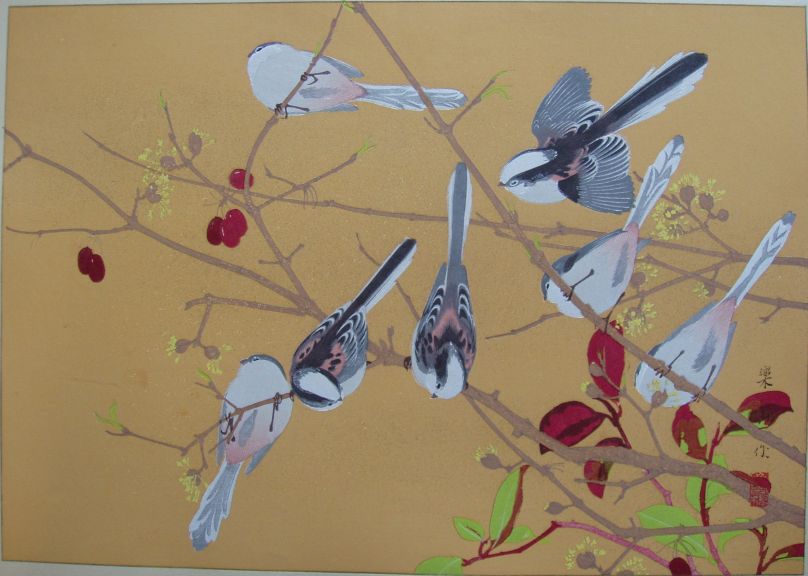

さんしゆにえなが (初春) [original as printed]
さんしゅゆにえなが (初春) [spelling corrected]
sanshuyu ni enaga (shoshun)
Cornelian Cherry and Long-tailed Tits (Early Spring)
サンシュユにエナガ (初春)
Original Number
79
ADDITIONAL NOTES FOR THIS DESIGN
| Edition I: | Edition I watermark | 楽山作 | Raku-zan Saku | + Seal A |
| Edition II*: | Edition II watermark | 楽山篁子生 | Raku-zan Kou-shi-sei | + Seal B |
| Edition III*: | watermark unknown | 楽山篁子生 | Raku-zan Kou-shi-sei | + Seal B |
[*A note on the two later versions of 79: There is currently only a single documented copy of each, and more copies will be needed to sort out just how to assign them correctly among the later editions. This arrangement is tentative at best.]
[For illustration of seals listed by seal code letter, see the Seals article. For edition characteristics applicable to this series as a whole, see the Edition article.]
Design History:This woodblock print was produced from an original painting on silk dating from the late 1920s whose current location is unknown. The indentification of this design as number 79 is original to Rakusan who published the print as the 79th design in his series of one hundred woodblock prints called 楽山花鳥畫譜, Rakuzan Kachou Gafu, lit. 'Rakusan's Flower and Bird Print Series'.
Edition I: Initial edition I printing and publication of 79 was in August 1932 (or perhaps slightly later), and it was delivered in installment forty (of fifty). Because this design appeared so late in the series, it may not have been reprinted before the series completion in 1933, and only the initial print run of about two hundred copies comprises edition I. Almost all of the documented copies of 79 come from edition I printings, including the example copy illustrated above.
Later Editions: Unfortunately, later edition copies of 79 are very rare, and currently only two somewhat different (and atypical) examples have been documented. It cannot yet be determined if those copies come from one or two very small print runs. One example is printed on edition II watermark paper which was produced to be used in edition II between 1935 and 1941. However, leftover edition II watermark paper was also used to reprint edition III copies early in the postwar period between 1948 and 1955. Edition III reprintings were usually also made in smaller print runs. The other example is known only from a reproduction of a later edition copy which has a secondary Foster era Rakusan cursive romaji signature, but the watermark is not visible (second illustration below). This Foster era signature is most typical of edition III reprintings, but edition II reprinting cannot be ruled out.
Rakusan mixed his own inks, and some areas in every design are known to be very soluble in at least one of the various solvents commonly used in restorations. The first later edition copy of 79 illustrated immediately below once had much the same colors as the greeting card reproduction (second image below). Regrettably, in order to address condition problems on this particular copy the entire print was immersed in a solvent bath. Several of the colors, including most of the greens of the foliage, have simply dissolved or floated away. The damaged copy is still interesting since it now shows hints of how Rakusan achieved his final effects using underprintings of sometimes very different colors, but it is otherwise ruined. It remains a sad object lesson illustrating the folly of using immersion techniques to 'restore' a Rakusan print.
 |
| 79 edition II* (print severely damaged from attempted immersion restoration) |
The other later edition copy of 79 was reproduced as a large, fine-art-quality, greeting card by Chryson's California. The carefully matched colors used in machine-printing this card accurately show the color differences of this later edition reprinting, including use of a much paler, more neutral tan background instead of the more saturated hue used for edition I.
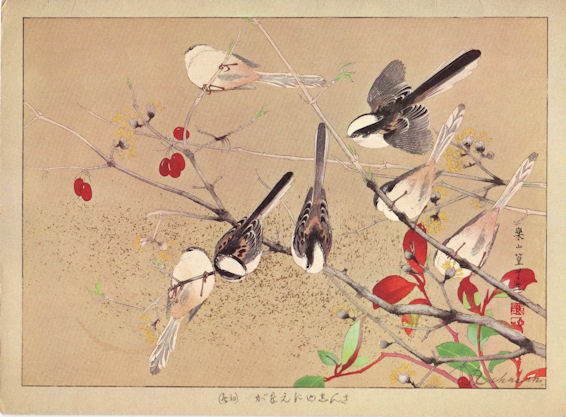 79 edition III* (machine-printed greeting card reproduction) |
The Chryson's greeting card was accompanied by a thin tissue paper insert on which is printed:
"JAPANESE BIRD PRINT.
The original art work for this fascinating lithographic reproduction was prepared by Rakusan Tsuchiya, a well-known contemporary Japanese wood block artist. The birds are Japanese Mountain Sparrows. Each one of the exquisite colors involves a separate operation in the original wood block print. We are told that many prints similar to this use as many as a hundred separate and distinct wood blocks."
The image area dimensions of the 79 greeting card are 6.5" x 9.25", which falls within the size range of the smallest of the similar Walter Foster reproductions (usually given as roughly 7" x 9"). The 79 card includes no direct mention of Foster, and 79 does not appear in the Foster booklet. However, the card would have been produced through some licensing arrangement with Foster who would have provided both the model print and also the insert text information obtained in part from Rakusan in Japan. The most likely scenario was that Foster assigned rights to the card to Chryson's in return for a consideration in printing the other fine art reproductions which Foster sold directly. Several mostly undatable copies of this greeting card are well documented, but it was known to be still in print in 1961 and probably was first sold in the mid to late 1950s.
[For additional general information on Foster, the booklet, or the fine art reproductions, see the Foster article.]
Copies in Public Collections:Edition I: Sidney and Lois Eskenazi Museum of Art, Indiana University, Bloomington, Indiana, USA; 76.41.7 [illustrated online].
Species Illustrated:
Japanese Cornelian Cherry (Japanese Cornel), Cornus officinalis, 山茱萸, さんしゅゆ, サンシュユ, sanshuyu, lit. 'mountain silverberry', is actually a kind of dogwood rather than a cherry. This shrub is native to Korea and China rather than Japan, and all three languages use versions of the original Chinese name. The original Silverberry, 茱萸 , しゅゆ, シュユ, shuyu, 'silverberry, Elaeagnus', is another, also unrelated, berry-producing shrub. The name Rakusan reproduced in the title-caption of the woodblock print has a typographical error omitting one of the kana characters. In 79 Rakusan included this species as brown, leafless, branches with tiny new yellow flowers as well as several lingering red fruits from the previous year.
Leafy branches of different as yet unidentified plant, perhaps an evergreen shrub, are included in the design in the lower right background. Its branches can be distinguished from the cornelian cherry not only by the red and green leaves but also by the red bark.
Long-tailed Tit, Aegithalos caudatus, 柄長, えなが, エナガ e-naga, lit. 'long-handle' (describing the long tail) is a very active small native Japanese bird.
The name 'Japanese Mountain Sparrow' used on the greeting card insert is not used for Long-tailed Tit. It instead refers to a different species, Varied Tit, which Rakusan used in design 57 (q.v.). The Japanese name for Varied Tit Parus varius is 山雀, やまがら, ヤマガラ, yama-gara, lit. 'mountain tit'. Although occasionally encountered, the reading of 山雀 as やますずめ, ヤマスズメ, yama-suzume, lit. 'mountain sparrow', is today considered incorrect. However, that rendition is clearly the source of the translated name 'Japanese Mountain Sparrow' which appears in the card insert.
Related Designs:

|

|
| 110-2 | 116-5 |